
The first song on Natalie Merchant's album Leave Your Sleep is Nursery Rhyme of Innocence and Experience, by Charles Causley, a title evocative of William Blake's Songs of Innocence and of Experience. I'm abashed that this song is my introduction to Causley's poetry. I don't know how to write about poetry in a way that isn't choked with cliches. I'd rather just read it, think about it, and appreciate it anew when it's set to music. However, if I had to choose one word to describe Causley's poetry, it would be the German sehnzucht, which roughly translates to yearning and longing. Here is a video of Merchant performing "Nursery Rhyme of Innocence and Experience."
This essay by Dana Gioia mentions Walter de la Mare as an influence. Yes. Causleys' work immediately reminded me of Mare's work, whose poems appear at first as if they are meant for children, but resonate with adults as well.
Showing posts with label poetry. Show all posts
Showing posts with label poetry. Show all posts
Tuesday, September 28, 2010


Wednesday, August 04, 2010
Whatever you lose (like a you or a me)
Here is a video of "Maggie and Milly and Molly and May," performed by Natalie Merchant and based upon the poem by E.E. Cummings. It's off of the album, "Leave Your Sleep." I read the poem aloud to my daughter, and then she wanted more Cummings poems. I realized that I was going to have to search for awhile in my Complete Poems collection for the ones appropriate for her, so I decided to switch to Carl Sandburg's collection for children called Wind Song. Has anyone set Sandburg's poems to music?
Friday, December 04, 2009
Jack Frost song
I uploaded the Jack Frost song yesterday on A Storytelling of Crows. You might wonder why I don't simply post these songs on this blog. However, I like to have a separate site with a specific focus of audio-visual resources for storytelling and music.
Wednesday, November 18, 2009
November is not my best writing month
What I have been working on these last few days:
1. Preparing for storytelling gigs.
2. Sewing for the store and for the school auction.
3. Getting ready for a week of visitors.
4. Trying to exercise with a sprained ankle.
Yesterday, my daughter told me about what she imagined the people of Jupiter were like: "They look like fairies and they fly around in hot air balloons." I thought, "There might be a story in there somewhere," but got no further than the title, which was The Aeronauts of Jupiter.
Obviously, I have not been kept up with my blog reading or commenting. There are times when I think, "Is this it, then? Should I celebrate my 5 year anniversary and then cease?" I'd rather not, but I don't want to post drivel. I'd rather keep it to myself. (I am satisfied to know that if my journals are not destroyed after my death, at least they are so illegible and uninteresting that no one will want to read them.)
And now on to something completely different: Poet Hans Ostrom visited this blog again to share a video made of Emily Dickenson and Elvis Presley in Heaven. I enjoyed the video (though the last part is supposed to be Emily and Elvis sleeping in their cabins, not next to each other!) mainly because it was satisfying to hear Ostrom's own voice reading the poem.
1. Preparing for storytelling gigs.
2. Sewing for the store and for the school auction.
3. Getting ready for a week of visitors.
4. Trying to exercise with a sprained ankle.
Yesterday, my daughter told me about what she imagined the people of Jupiter were like: "They look like fairies and they fly around in hot air balloons." I thought, "There might be a story in there somewhere," but got no further than the title, which was The Aeronauts of Jupiter.
Obviously, I have not been kept up with my blog reading or commenting. There are times when I think, "Is this it, then? Should I celebrate my 5 year anniversary and then cease?" I'd rather not, but I don't want to post drivel. I'd rather keep it to myself. (I am satisfied to know that if my journals are not destroyed after my death, at least they are so illegible and uninteresting that no one will want to read them.)
And now on to something completely different: Poet Hans Ostrom visited this blog again to share a video made of Emily Dickenson and Elvis Presley in Heaven. I enjoyed the video (though the last part is supposed to be Emily and Elvis sleeping in their cabins, not next to each other!) mainly because it was satisfying to hear Ostrom's own voice reading the poem.
Wednesday, June 24, 2009
Science to Science-Fiction to Silliness
New York Times article: Vatican’s Celestial Eye, Seeking Not Angels but Data, by George Johnson:
Last year, in an opening address at a conference in Rome, called “Science 400 Years After Galileo Galilei,” Cardinal Tarcisio Bertone, the secretary of state of the Vatican, praised the church’s old antagonist as “a man of faith who saw nature as a book written by God.” In May, as part of the International Year of Astronomy, a Jesuit cultural center in Florence conducted “a historical, philosophical and theological re-examination” of the Galileo affair. But in the effort to rehabilitate the church’s image, nothing speaks louder than a paper by a Vatican astronomer in, say, The Astrophysical Journal or The Monthly Notices of the Royal Astronomical Society.
While we're on the subject of outer space, let me call attention to a poem about the astronomer Tycho Brahe that my mom reintroduced to me during my Santa Fe visit: The Old Astronomer, by Sarah Williams. I suspect my first exposure to the poem might have come through Madeleine L'Engle in one of her Crosswicks journals, but I'm not sure. (Those of you with fresher memories, do you know?) The lines that resonate:
Though my soul may set in darkness,
it will rise in perfect light.
I have loved the stars too fondly
to be fearful of the night.
When we were in Santa Fe, Bede and I went out one night to look at the stars. We could see them clearly as we were far away from the city lights. Like so many others, we wished we could go out to the stars. We're convinced we're not alone in the universe, but think it's probably no mistake that we're all so far apart. Look what we do on our own planet.
Speaking of our own planet, I just picked up The Many Colored Land, by Julian May. It's a science-fiction novel published in the early 1980's about people in the future who decide to travel back in time on a one-way ticket to the Pliocene epoch in the hopes of living out the rest of their lives without being pestered. Instead, they encounter enslavement by an alien race that landed on Earth as part of their own exile. It's up to our intrepid heroes to save Earth from those dastardly aliens so they don't ruin it for the humans millions of years later.
I'm surprised that no one has yet made a television series out of this concept. I suspect that if they did, they'd change the epoch so they could fit in dinosaurs somehow a la Land of the Lost.
Last year, in an opening address at a conference in Rome, called “Science 400 Years After Galileo Galilei,” Cardinal Tarcisio Bertone, the secretary of state of the Vatican, praised the church’s old antagonist as “a man of faith who saw nature as a book written by God.” In May, as part of the International Year of Astronomy, a Jesuit cultural center in Florence conducted “a historical, philosophical and theological re-examination” of the Galileo affair. But in the effort to rehabilitate the church’s image, nothing speaks louder than a paper by a Vatican astronomer in, say, The Astrophysical Journal or The Monthly Notices of the Royal Astronomical Society.
While we're on the subject of outer space, let me call attention to a poem about the astronomer Tycho Brahe that my mom reintroduced to me during my Santa Fe visit: The Old Astronomer, by Sarah Williams. I suspect my first exposure to the poem might have come through Madeleine L'Engle in one of her Crosswicks journals, but I'm not sure. (Those of you with fresher memories, do you know?) The lines that resonate:
Though my soul may set in darkness,
it will rise in perfect light.
I have loved the stars too fondly
to be fearful of the night.
When we were in Santa Fe, Bede and I went out one night to look at the stars. We could see them clearly as we were far away from the city lights. Like so many others, we wished we could go out to the stars. We're convinced we're not alone in the universe, but think it's probably no mistake that we're all so far apart. Look what we do on our own planet.
Speaking of our own planet, I just picked up The Many Colored Land, by Julian May. It's a science-fiction novel published in the early 1980's about people in the future who decide to travel back in time on a one-way ticket to the Pliocene epoch in the hopes of living out the rest of their lives without being pestered. Instead, they encounter enslavement by an alien race that landed on Earth as part of their own exile. It's up to our intrepid heroes to save Earth from those dastardly aliens so they don't ruin it for the humans millions of years later.
I'm surprised that no one has yet made a television series out of this concept. I suspect that if they did, they'd change the epoch so they could fit in dinosaurs somehow a la Land of the Lost.
Friday, March 27, 2009
Allusions and oatmeal
While I applaud everyone who does features for April is National Poetry Month, I must admit I've never felt the particular call to follow suit. For me, it's like eating steel-cut oatmeal 4 times a week for 48 weeks and then participating in National Steel-Cut Oatmeal Month. I know I'm one of the lucky ones, and there are people who have scant exposure to steel-cut oatmeal, but I have full confidence that other bloggers will make up for my slacker attitude.
I will be celebrating April Fool's Day with Minh Le of Bottom Shelf Books and whomever else participates in our contest next week. The "April Fool" is not that we're pulling your leg about putting your creativity to work and winning fabulous prizes, but that we want you to have a silly, fun time doing it without feeling like a fool. We're very serious about that. We promise not to tape a paper fish onto your back.... or at least, attempt the resist the urge. Stay tuned for details to come in just 5 days.
In the meantime, here's a diversion:
Presenting the "Interview With Your Daughter" Meme conducted on Thursday, March 26, 2009. Lucia's answers are in italics.
1. What is something I always say to you?
I love you.
2. What makes me happy?
You hugging and kissing me.
3. What makes me sad?
Being grouchy.
4. How do I make you laugh?
We would watch silly things together.
5. What do you think I was like as a child?
With brown hair and brown eyes and a black dress.
6. How old am I?
36
7. How tall am I?
This tall. [Hands stretched up]
8. What is my favorite thing to do?
Tell stories.
9. What do I do when you're not around?
Say grownup stuff.
10. If I become famous, what will it be for?
Being a composer.
11. What am I really good at?
Playing guitar.
12. What am I not really good at?
Doing magic tricks.
13. What is my job?
Making dollies.
14. What is my favorite food?
Pizza.
15. What makes you proud of me?
You hugging me and kissing me.
16. If I were a cartoon character, who would I be?
Cinderella.
17. What do you and I do together?
Sing.
18. How are we the same?
We both have brown hair and brown eyes.
19. How are you and I different?
You having pierced ears and me not.
20. How do you know that I love you?
Because you often hug and kiss me.
21. Where is my favorite place to go?
Your favorite place to go I think is California.
23. What do I love about Daddy?
Him working with the computer.
And there you have it!
Julia Larios of The Drift Record is hosting Steel-Cut Oatmeal Friday this week.
I will be celebrating April Fool's Day with Minh Le of Bottom Shelf Books and whomever else participates in our contest next week. The "April Fool" is not that we're pulling your leg about putting your creativity to work and winning fabulous prizes, but that we want you to have a silly, fun time doing it without feeling like a fool. We're very serious about that. We promise not to tape a paper fish onto your back.... or at least, attempt the resist the urge. Stay tuned for details to come in just 5 days.
In the meantime, here's a diversion:
Presenting the "Interview With Your Daughter" Meme conducted on Thursday, March 26, 2009. Lucia's answers are in italics.
1. What is something I always say to you?
I love you.
2. What makes me happy?
You hugging and kissing me.
3. What makes me sad?
Being grouchy.
4. How do I make you laugh?
We would watch silly things together.
5. What do you think I was like as a child?
With brown hair and brown eyes and a black dress.
6. How old am I?
36
7. How tall am I?
This tall. [Hands stretched up]
8. What is my favorite thing to do?
Tell stories.
9. What do I do when you're not around?
Say grownup stuff.
10. If I become famous, what will it be for?
Being a composer.
11. What am I really good at?
Playing guitar.
12. What am I not really good at?
Doing magic tricks.
13. What is my job?
Making dollies.
14. What is my favorite food?
Pizza.
15. What makes you proud of me?
You hugging me and kissing me.
16. If I were a cartoon character, who would I be?
Cinderella.
17. What do you and I do together?
Sing.
18. How are we the same?
We both have brown hair and brown eyes.
19. How are you and I different?
You having pierced ears and me not.
20. How do you know that I love you?
Because you often hug and kiss me.
21. Where is my favorite place to go?
Your favorite place to go I think is California.
23. What do I love about Daddy?
Him working with the computer.
And there you have it!
Julia Larios of The Drift Record is hosting Steel-Cut Oatmeal Friday this week.
Friday, February 06, 2009
Sunbeams and lanterns in late winter

Photo from the BBC South Yorkshire Winter Photos site
The golden crocus reaches up
To catch a sunbeam in her cup. -Walter Crane
Last May, when I had just received my new camera with the video feature, I recorded my daughter singing the Crocus song she learned at school. Despite the rough quality and the click at the end (I hadn't yet figured out how to edit, so everything was a one-take feature), you at least hear the tune for the song:
Crocus, crocus, waking up
Catch a sunbeam in your cup
Hold it tight, let it go,
Li-la, Li-la, li-lay-lo.
In the stories my family tells, crocuses and snowdrops are best friends because they're usually the first bulb flowers to poke their noses out of the ground. Recently, I composed a verse for the snowdrop:
Snowdrop, snowdrop, hanging down
Lantern shining in the town
Cold winds blow, you still grow,
Li-la, Li-la, li-lay-lo.

Photo from Irish Gardeners
You may wonder just where that snowdrop lantern shining in the town may be. Check a copy of Voices in the Park, by Anthony Browne. You'll find it. Speaking of Voices in the Park, I've had that book for years, and for awhile, each time I read it aloud to my daughter, I discovered something in the pictures I hadn't noticed before.
Friday, January 30, 2009
Nature Table Figures: The Spring Collection
Ever since 1987, I've wanted to write for the J. Peterman Company. Whenever I write a description for an auction catalog item, J. Peterman's influence is present. I keep meaning to dig out the letter J. Peterman wrote to me in response to an impassioned plea to bring back the "Jane Austen dress," a simple but elegant gown I wanted to wear for my theoretical wedding.
Here my Spring Shade Garden Collection nature table dolls for the school auction:


Johnny Jump-Up, Wake-Robin Trillium, and Bleeding Heart
1. Johnny Jump-Up is a 5 ½ nature table figure inspired by the part-shade perennial also known as heartsease and referred to as “Love-in-idleness” by Oberon, King of the Fairies, in Shakespeare’s A Midsummer Night’s Dream.* This garden jester is dressed in yellow, purple and green with a removable lined vest. He is created out of wool and cotton plus metal pipe-cleaners for the arms, legs and flower staff. He can stand without support as long as his legs are bowed. Johnny-Jump Up will bring color and joy to your early summer nature table for years provided he is kept out of reach from animals and children who still put toys in their mouths.
2.Wake-Robin Trillium is a 5 ¼ inch nature table figure inspired by the three-petal woodland perennial. Most trillium flowers are white, but Wake-Robin wears a skirt of three deep red petals complemented by three dark green leaves. A simple garland of green merino wool adorns her auburn French twist. She is created out of wool and cotton plus metal pipe-cleaners for the arms and flower staff as well as metallic embroidery threads that border the sleeves and underskirt. While you should never pick trillium from the wild without a permit, Lady Wake-Robin will gladly come indoors to grace your spring nature table. However, she should be kept out of reach from animals and children who still put toys in their mouths.
3.Bleeding Heart is a 5 ¼ inch nature table figure inspired by the heart-shaped garden perennial and created for the person who can’t get enough of the color pink. Her ball-gown is decorated with tête de boeuf, wheat-ear, chain, petal and point russe embroidery stitches. Gold metallic thread winds through her hair of many braids. She is created out of wool and cotton plus metal pipe-cleaners for the arms and flower staff. While her natural counterpart is a shade-plant, Lady Bleeding Heart does not shrink from the spotlight. However, in order to assure that she blooms for months and returns the following year, she should be kept out of reach from animals and children who still put toys in their mouths.
*That very time I saw, but thou couldst not,
Flying between the cold moon and the earth,
Cupid all arm'd: a certain aim he took
At a fair vestal throned by the west,
And loosed his love-shaft smartly from his bow,
As it should pierce a hundred thousand hearts;
But I might see young Cupid's fiery shaft
Quench'd in the chaste beams of the watery moon,
And the imperial votaress passed on,
In maiden meditation, fancy-free.
Yet mark'd I where the bolt of Cupid fell:
It fell upon a little western flower,
Before milk-white, now purple with love's wound,
And maidens call it love-in-idleness.
Fetch me that flower; the herb I shew'd thee once:
The juice of it on sleeping eye-lids laid
Will make or man or woman madly dote
Upon the next live creature that it sees.
--A Midsummer Night's Dream, Act II, Scene 1
Here my Spring Shade Garden Collection nature table dolls for the school auction:


Johnny Jump-Up, Wake-Robin Trillium, and Bleeding Heart
1. Johnny Jump-Up is a 5 ½ nature table figure inspired by the part-shade perennial also known as heartsease and referred to as “Love-in-idleness” by Oberon, King of the Fairies, in Shakespeare’s A Midsummer Night’s Dream.* This garden jester is dressed in yellow, purple and green with a removable lined vest. He is created out of wool and cotton plus metal pipe-cleaners for the arms, legs and flower staff. He can stand without support as long as his legs are bowed. Johnny-Jump Up will bring color and joy to your early summer nature table for years provided he is kept out of reach from animals and children who still put toys in their mouths.
2.Wake-Robin Trillium is a 5 ¼ inch nature table figure inspired by the three-petal woodland perennial. Most trillium flowers are white, but Wake-Robin wears a skirt of three deep red petals complemented by three dark green leaves. A simple garland of green merino wool adorns her auburn French twist. She is created out of wool and cotton plus metal pipe-cleaners for the arms and flower staff as well as metallic embroidery threads that border the sleeves and underskirt. While you should never pick trillium from the wild without a permit, Lady Wake-Robin will gladly come indoors to grace your spring nature table. However, she should be kept out of reach from animals and children who still put toys in their mouths.
3.Bleeding Heart is a 5 ¼ inch nature table figure inspired by the heart-shaped garden perennial and created for the person who can’t get enough of the color pink. Her ball-gown is decorated with tête de boeuf, wheat-ear, chain, petal and point russe embroidery stitches. Gold metallic thread winds through her hair of many braids. She is created out of wool and cotton plus metal pipe-cleaners for the arms and flower staff. While her natural counterpart is a shade-plant, Lady Bleeding Heart does not shrink from the spotlight. However, in order to assure that she blooms for months and returns the following year, she should be kept out of reach from animals and children who still put toys in their mouths.
*That very time I saw, but thou couldst not,
Flying between the cold moon and the earth,
Cupid all arm'd: a certain aim he took
At a fair vestal throned by the west,
And loosed his love-shaft smartly from his bow,
As it should pierce a hundred thousand hearts;
But I might see young Cupid's fiery shaft
Quench'd in the chaste beams of the watery moon,
And the imperial votaress passed on,
In maiden meditation, fancy-free.
Yet mark'd I where the bolt of Cupid fell:
It fell upon a little western flower,
Before milk-white, now purple with love's wound,
And maidens call it love-in-idleness.
Fetch me that flower; the herb I shew'd thee once:
The juice of it on sleeping eye-lids laid
Will make or man or woman madly dote
Upon the next live creature that it sees.
--A Midsummer Night's Dream, Act II, Scene 1
Friday, August 08, 2008
Loss and Life in Books and Beyond
This day has come around again. Thanks to Elaine Magliaro for introducing me to Sherman Alexie's Grief Calls Us to the Things Of This World, for that is the poem that comes to mind today on this breezy sunny day in Seattle.
For the past three days, I have been reading aloud E. B. White's Charlotte's Web to Lucia. Thanks to both my husband and Seven Impossible Things Before Breakfast for alerting me to this NPR piece about the book. I thought of E. B. White having to do seventeen takes when reading the sad parts for the audio recording after Lucia said, "Stop talking in that funny voice!" as I cried during the key moments. The final paragraphs are what always get me: the paen to friendship and good writing is as fine an epitaph as any I've ever read.
Finally, I remember when Lucia's first tooth came in. Now, that tooth has popped out, and Lucia is a big girl now, just like Peter Sis' Madlenka. "How wise I am!" Lucia exclaimed yesterday. Here she is, displaying her sagacity:

Not too long ago, Yorkshire Pudding introduced me to Miranda the Fairy, who used to leave his children little notes. Miranda the Fairy has a new job in the dental department of fairyland She left Lucia a little note with two books by Elsa Beskow in minature: Pelle's New Suit and Peter in Blueberry Land. I suspect that future tooth presents will be more modest.
For the past three days, I have been reading aloud E. B. White's Charlotte's Web to Lucia. Thanks to both my husband and Seven Impossible Things Before Breakfast for alerting me to this NPR piece about the book. I thought of E. B. White having to do seventeen takes when reading the sad parts for the audio recording after Lucia said, "Stop talking in that funny voice!" as I cried during the key moments. The final paragraphs are what always get me: the paen to friendship and good writing is as fine an epitaph as any I've ever read.
Finally, I remember when Lucia's first tooth came in. Now, that tooth has popped out, and Lucia is a big girl now, just like Peter Sis' Madlenka. "How wise I am!" Lucia exclaimed yesterday. Here she is, displaying her sagacity:

Not too long ago, Yorkshire Pudding introduced me to Miranda the Fairy, who used to leave his children little notes. Miranda the Fairy has a new job in the dental department of fairyland She left Lucia a little note with two books by Elsa Beskow in minature: Pelle's New Suit and Peter in Blueberry Land. I suspect that future tooth presents will be more modest.
Tuesday, November 27, 2007
Runcible Spoon

Lear's drawing of a Dolomphious Duck using a runcible spoon to catch spotted frogs for dinner
After listening to Edward Lear's poem The Owl and the Pussycat, Lucia wondered, "What's a runcible spoon?" The term comes from the last stanza:
They dined on mince, and slices of quince,
Which they ate with a runcible spoon;
And hand in hand, on the edge of the sand,
They danced by the light of the moon...
Lear probably didn't have a specific idea as to what a runcible spoon really was, but descriptions of the utensil as a spoon with prongs or a curved fork that has a bit of a bowl to it led me to conclude one thing: the runcible spoon is our modern-day spork. However, "spork" is so inelegant. Really, there ought to be a differention. When you partake of fine cuisine (mince, slices of quince, spotted frogs), you use a runcible spoon:

However, if you are forced to consume cafeteria food, you definitely need a spork:

You might ask, "All this exposition over obscure cutlery is well and good; however, in which hand should we hold the runcible spoon?" The answer is simple, my friends: follow the local customs of the country in which you happen to dine. If that tactic fails, ask yourself, "What would Edward Lear do?" (henceforth known as WWELD).
Friday, September 07, 2007
Labor Day Acrostic
For Tricia's (The Miss Rumphius Effect) Monday Poetry Stretch, Terrell of Alone on a Limb presents a Labor Day Acrostic and an informal essay on the appreciation of past and present day laborers. (As far as unions go, I have mixed feelings: when they work, they're great, and when the don't work, they're exploitative. Sound familiar?) Go read. Go think.
With this essay and existence in general, I keep coming back to Rilke's Archaic Torso of Apollo: "You must change your life." It sounds more emphatic in German: "Du musst dein Leben ändern."
With this essay and existence in general, I keep coming back to Rilke's Archaic Torso of Apollo: "You must change your life." It sounds more emphatic in German: "Du musst dein Leben ändern."
Monday, September 03, 2007
Monday Poetry Stretch-Acrostic
Today's Poetry Monday Stretch at The Miss Rumphius Effect is an acrostic. An acrostic is a poem in which the first letter of the lines, read downwards, form a word. I had a friend in high school who wrote two acrostics using my full four names. He had romantic feelings for me, and I wish I could have returned them, but I didn't. He knew that we would always be "just friends," and he was respectfully appreciative without encroaching upon my space. I still cringe when I remember that he asked me what I wanted for my birthday, and I snapped, "A scale that works!" because I was so frustrated with my weight. When my birthday arrived, he brought a bathroom scale to the art room where I had my first class of the day. I was mortified. I wish now that I had just realized how silly I was, accepted the bathroom scale with grace, and made a mental note that I had a friend who cared about me so much that he would give me what I had literally asked for. This acrostic is dedicated to that boy:
Regrets, I have regrets. Not of things I did but
Unkind thoughts and thoughtless words
Expectations too full-blown to carry any weight
Fretting by the mirror, stomping on the scale
Unwilling to pause, breathe, and move into grace.
Long ago they were, yet not so far behind.
On a lighter note, tomorrow is the premiere of Spinning Wheel, my new children's performer series. I will be interviewing Eric Herman, a children's musician who also blogs Cool Tunes for Kids.
Regrets, I have regrets. Not of things I did but
Unkind thoughts and thoughtless words
Expectations too full-blown to carry any weight
Fretting by the mirror, stomping on the scale
Unwilling to pause, breathe, and move into grace.
Long ago they were, yet not so far behind.
On a lighter note, tomorrow is the premiere of Spinning Wheel, my new children's performer series. I will be interviewing Eric Herman, a children's musician who also blogs Cool Tunes for Kids.
Sunday, September 02, 2007
Two things
Hey! Tomorrow I'm heading over to The Miss Rumphius Effect for Tricia's Monday Poetry Stretch. As Robert Frost would say, "You come too."
Evolution, Me and Other Freaks of Nature by Robin Brande is finally out. I'm still waiting to read my copy because I was out of town when the book came out. Now I have to wait until after Labor Day to pick it up from my local independent bookseller. See? I'm trying to wean myself from big A.
Evolution, Me and Other Freaks of Nature by Robin Brande is finally out. I'm still waiting to read my copy because I was out of town when the book came out. Now I have to wait until after Labor Day to pick it up from my local independent bookseller. See? I'm trying to wean myself from big A.
Tuesday, April 24, 2007
It's Got a Beat, You Can Sing (and Dance) to It
I asked Elaine Magliaro from Wild Rose Reader to give me a poem she'd like to hear set to music. She gave me four. How cool is that? (Answer: quite cool).
Here's her post of Poems to Set to Music.
Here's her post of Poems to Set to Music.
Tuesday, April 17, 2007
Doing My Bit for National Poetry Month
Replay:
Arithmetic is where numbers fly is an old post I wrote about Carl Sandburg. The post has a link to the short film made from Carl Sandburg's "Arithmetic." Real Player required (alas).
Leatherwing Bat on the Ocarina is a song I transcribed a few months before I began guitar lessons. It's an Appalachian folk song I wish I had written. I'm playing the song for my guitar recital this Sunday.
Three Songs of Stars and Fire contains one of my favorite poems, "A Pavane for the Nursery," by William Jay Smith.
Rainier Maria Rilke and Richard Wilbur write about angels and the things of this world.
My one Poetry Friday post has links to Walter de la Mare, Pablo Neruda, Edward Lear and Robert Louis Stevenson.
All of the poems and songs I cited in the above links are by poets who are men. It's something I find peculiar to note, because there was a time in my life when I went out of my way to read and study poetry by women. My theory: male poets sometimes talk about their "Muses," and the traditional Muses are female. Maybe because I'm female, my non-traditional Muse is male. If so, I need to give him a name. Thalia is the Muse of comedy and Euterpe is the Muse of lyric poetry. What is the Ancient Greek translation for "Muse of Silly Songs?"
Thalerpe?
Addendum
Robert from the comments section suggests "Anoitos" as the Muse of Silly Songs. Anoitos means "fool." (Thank you, Babel Fish, for allowing me to appear more erudite than I really am.) It works for me:
Sing, O Anoitos,
the vanity of Achilles son of Heelius,
that brought countless blisters upon the Achaeans.
Many a brave sole wore sandals hurrying down to Macy's,
and many a bunion did it yield...
Oh, I can't sustain this.
Arithmetic is where numbers fly is an old post I wrote about Carl Sandburg. The post has a link to the short film made from Carl Sandburg's "Arithmetic." Real Player required (alas).
Leatherwing Bat on the Ocarina is a song I transcribed a few months before I began guitar lessons. It's an Appalachian folk song I wish I had written. I'm playing the song for my guitar recital this Sunday.
Three Songs of Stars and Fire contains one of my favorite poems, "A Pavane for the Nursery," by William Jay Smith.
Rainier Maria Rilke and Richard Wilbur write about angels and the things of this world.
My one Poetry Friday post has links to Walter de la Mare, Pablo Neruda, Edward Lear and Robert Louis Stevenson.
All of the poems and songs I cited in the above links are by poets who are men. It's something I find peculiar to note, because there was a time in my life when I went out of my way to read and study poetry by women. My theory: male poets sometimes talk about their "Muses," and the traditional Muses are female. Maybe because I'm female, my non-traditional Muse is male. If so, I need to give him a name. Thalia is the Muse of comedy and Euterpe is the Muse of lyric poetry. What is the Ancient Greek translation for "Muse of Silly Songs?"
Thalerpe?
Addendum
Robert from the comments section suggests "Anoitos" as the Muse of Silly Songs. Anoitos means "fool." (Thank you, Babel Fish, for allowing me to appear more erudite than I really am.) It works for me:
Sing, O Anoitos,
the vanity of Achilles son of Heelius,
that brought countless blisters upon the Achaeans.
Many a brave sole wore sandals hurrying down to Macy's,
and many a bunion did it yield...
Oh, I can't sustain this.
Friday, November 03, 2006
Poetry Friday
When I was a newbie librarian, I was ambitious about introducting poetry into my storytimes. For the poem "Someone," I turned down the lights and asked children to keep the beat by knocking on the floor. These days, I'd play the guitar and make up a simple melody for the poem. I've found that I can get away with presenting poetry when I set it to music. Now, you know my secret. It's a handy one to have if you ever need to memorize poetry.
SOMEONE
Someone came knocking
At my wee, small door;
Someone came knocking,
I'm sure - sure - sure;
I listened, I opened,
I looked to left and right,
But naught there was a-stirring
In the still dark night;
Only the busy beetle
Tap-tapping in the wall,
Only from the forest
The screech-owl's call,
Only the cricket whistling
While the dewdrops fall,
So I know not who came knocking,
At all, at all, at all.
--Walter de la Mare
Other poems I'd like to set to my own simple melodies for storytimes:
The Quangle-Wangle's Hat--Edward Lear
Ode to Common Things--Pablo Neruda (full-text poem linked via a blog called Pomegranates and Paper... oh yeah, and the "common thing" of a handbag featured is lovely indeed)
The Swing--Robert Louis Stevenson
SOMEONE
Someone came knocking
At my wee, small door;
Someone came knocking,
I'm sure - sure - sure;
I listened, I opened,
I looked to left and right,
But naught there was a-stirring
In the still dark night;
Only the busy beetle
Tap-tapping in the wall,
Only from the forest
The screech-owl's call,
Only the cricket whistling
While the dewdrops fall,
So I know not who came knocking,
At all, at all, at all.
--Walter de la Mare
Other poems I'd like to set to my own simple melodies for storytimes:
Monday, October 02, 2006
The way I want to write:
Ars Poetica
by Archibald MacLeish
A poem should be palpable and mute
As a globed fruit,
Dumb
As old medallions to the thumb,
Silent as the sleeve-worn stone
Of casement ledges where the moss has grown--
A poem should be wordless
As the flight of birds.
*
A poem should be motionless in time
As the moon climbs,
Leaving, as the moon releases
Twig by twig the night-entangled trees,
Leaving, as the moon behind the winter leaves,
Memory by memory the mind--
A poem should be motionless in time
As the moon climbs.
*
A poem should be equal to:
Not true.
For all the history of grief
An empty doorway and a maple leaf.
For love
The leaning grasses and two lights above the sea--
A poem should not mean
But be.
by Archibald MacLeish
A poem should be palpable and mute
As a globed fruit,
Dumb
As old medallions to the thumb,
Silent as the sleeve-worn stone
Of casement ledges where the moss has grown--
A poem should be wordless
As the flight of birds.
*
A poem should be motionless in time
As the moon climbs,
Leaving, as the moon releases
Twig by twig the night-entangled trees,
Leaving, as the moon behind the winter leaves,
Memory by memory the mind--
A poem should be motionless in time
As the moon climbs.
*
A poem should be equal to:
Not true.
For all the history of grief
An empty doorway and a maple leaf.
For love
The leaning grasses and two lights above the sea--
A poem should not mean
But be.
Tuesday, September 12, 2006
Day of the Bat
A bat is born,
Naked and blind and pale
His mother makes a pocket of her tail
And catches him. He clings
to her long fur
By his thumbs and toes and teeth.
And then the mother dances through the night
Doubling and looping,
Soaring, somersaulting-
Her baby hangs on
underneath.
All night, in happiness,
She hunts and flies.
Her high sharp cries
Like shining needlepoints of sound
Go out into the night and
echoing back,
Tell her what they have touched.
She hears how far it is,
how big it is,
which way it's going:
She lives by hearing.
--from The Bat Poet, by Randall Jarrell, illustrated by Maurice Sendak
In college, my children's literature professor told me, "Of course you like The Bat Poet. That's a book usually only children's librarians like." The basic premise is this: a little brown bat discovers that daylight reveals a completely different, totally fascinating world. He tries to get his fellow bats to stay awake with him, but they refuse. As the bat continues to "stay up" during the day, he meets an assortment of creatures, including a chipmunk who's a great listener, and a self-absorbed mockingbird who claims to have the corner-market on the correct forms of poetry.
While the story intrigued me, it was Sendak's illustrations that catapaulted me into my fascination with bats. I like their looks, the elegant silhouettes of the different wing-spans, the way their wings are actually their hands. At one point in time, I could fill your head with all sorts of facts about bats, where they showed up in folklore, as well as their prevalence in popular culture. You could get me fuming by dismissing bats as "rabid animals that fly into your hair." Hey, there are more people bitten by rabid cats, dogs, squirrels and raccoons. Everyone thinks they're cute.
I bring this subject up now because a new non-fiction children's book about bats was published a few months ago, and I want to read it. It's called Little Lost Bat, by Sandra Markle, illustrated by Alan Marks. If you get to it before I do, let me know what you think.
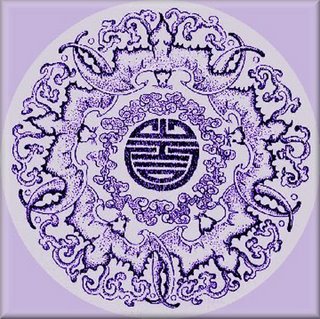
By the way, in China, bats are representative of happiness and good fortune. You've probably seen some version of the five bats (Longevity, Wealth, Health, Love and a Natural Death at a Ripe Age:
I still collect folktales about bats. One of my favorite ones comes from Cote d'Ivoire. To be continued...
Naked and blind and pale
His mother makes a pocket of her tail
And catches him. He clings
to her long fur
By his thumbs and toes and teeth.
And then the mother dances through the night
Doubling and looping,
Soaring, somersaulting-
Her baby hangs on
underneath.
All night, in happiness,
She hunts and flies.
Her high sharp cries
Like shining needlepoints of sound
Go out into the night and
echoing back,
Tell her what they have touched.
She hears how far it is,
how big it is,
which way it's going:
She lives by hearing.
--from The Bat Poet, by Randall Jarrell, illustrated by Maurice Sendak
In college, my children's literature professor told me, "Of course you like The Bat Poet. That's a book usually only children's librarians like." The basic premise is this: a little brown bat discovers that daylight reveals a completely different, totally fascinating world. He tries to get his fellow bats to stay awake with him, but they refuse. As the bat continues to "stay up" during the day, he meets an assortment of creatures, including a chipmunk who's a great listener, and a self-absorbed mockingbird who claims to have the corner-market on the correct forms of poetry.
While the story intrigued me, it was Sendak's illustrations that catapaulted me into my fascination with bats. I like their looks, the elegant silhouettes of the different wing-spans, the way their wings are actually their hands. At one point in time, I could fill your head with all sorts of facts about bats, where they showed up in folklore, as well as their prevalence in popular culture. You could get me fuming by dismissing bats as "rabid animals that fly into your hair." Hey, there are more people bitten by rabid cats, dogs, squirrels and raccoons. Everyone thinks they're cute.
I bring this subject up now because a new non-fiction children's book about bats was published a few months ago, and I want to read it. It's called Little Lost Bat, by Sandra Markle, illustrated by Alan Marks. If you get to it before I do, let me know what you think.
By the way, in China, bats are representative of happiness and good fortune. You've probably seen some version of the five bats (Longevity, Wealth, Health, Love and a Natural Death at a Ripe Age:

I still collect folktales about bats. One of my favorite ones comes from Cote d'Ivoire. To be continued...
Wednesday, August 09, 2006
Juvenalia Intacta
My mom sent me two packages of various items she'd kept for me over the years. In one of the packages was my complete juvenalia... not just the poems, but the short stories. I had photocopies of some of the poems, but I thought the juvenalia was probably lost in a basement flood (or basement fire, or something of that ilk).
Until I went to college, I would type in my age next to my name because I thought it was important. I thought that I was probably going to become so famous that my juvenalia would be in big, big demand. While it's fair to say there are some items that are thoughtful and well-developed for my various ages, the collection will probably be more of interest to my daughter when she's a bit older and writing stories of her own. Do I assume too much? I don't think so.
Addendum for Nonny:
I'm looking through the juvenalia for a story or poem to post. Can't. Do. It. I feel protective of my younger self. There are many cliches, exclamation points, urgent appeals to vampires (i.e. "night angels")... you know, the usual stuff. I was trying so hard to be serious and profound. I'm not saying that in a disparaging tone of voice: I really wanted to be serious and profound. Sometimes I tried to be funny, but it was forced humor. If I am going to be honest with myself (and by extension, everyone else), one of my overarching reasons for wanting to write was so that I could become famous and successful, and thereby show everybody that I was extraordinary after all.
Okay. One poem. I was twelve years old, heading for my thirteenth birthday. The year: 1984. The setting: Seventh grade English class. I've forgotten the specific creative writing journal assignment. It was one of the few times in which I was oblivious to any agenda:
River Rapids
River rapids
Flowing, crashing, thundering, breaking.
The little boat tosses and rocks with the waves.
Over and over again,
Flowing, crashing, thundering, breaking.
The river is harsh and loud,
but its continuing music is a lullaby.
Slowly, slowly, I drift off to sleep.
Drifting slowly and smoothly, the little boat comes to a stop.
The movements in the waves put me to sleep.
Now silence wakes me up.
My little boat is floating in a stream.
Sunlight breaks on the water, causing it to glisten with gold.
Green mossy banks and giant oaks surround me right and left.
The rapids are gone, I've finally stopped.
I'm safe now, able to stand up.
Yet, I felt safer when my life was in danger.
Until I went to college, I would type in my age next to my name because I thought it was important. I thought that I was probably going to become so famous that my juvenalia would be in big, big demand. While it's fair to say there are some items that are thoughtful and well-developed for my various ages, the collection will probably be more of interest to my daughter when she's a bit older and writing stories of her own. Do I assume too much? I don't think so.
Addendum for Nonny:
I'm looking through the juvenalia for a story or poem to post. Can't. Do. It. I feel protective of my younger self. There are many cliches, exclamation points, urgent appeals to vampires (i.e. "night angels")... you know, the usual stuff. I was trying so hard to be serious and profound. I'm not saying that in a disparaging tone of voice: I really wanted to be serious and profound. Sometimes I tried to be funny, but it was forced humor. If I am going to be honest with myself (and by extension, everyone else), one of my overarching reasons for wanting to write was so that I could become famous and successful, and thereby show everybody that I was extraordinary after all.
Okay. One poem. I was twelve years old, heading for my thirteenth birthday. The year: 1984. The setting: Seventh grade English class. I've forgotten the specific creative writing journal assignment. It was one of the few times in which I was oblivious to any agenda:
River Rapids
River rapids
Flowing, crashing, thundering, breaking.
The little boat tosses and rocks with the waves.
Over and over again,
Flowing, crashing, thundering, breaking.
The river is harsh and loud,
but its continuing music is a lullaby.
Slowly, slowly, I drift off to sleep.
Drifting slowly and smoothly, the little boat comes to a stop.
The movements in the waves put me to sleep.
Now silence wakes me up.
My little boat is floating in a stream.
Sunlight breaks on the water, causing it to glisten with gold.
Green mossy banks and giant oaks surround me right and left.
The rapids are gone, I've finally stopped.
I'm safe now, able to stand up.
Yet, I felt safer when my life was in danger.
Friday, April 28, 2006
The Hat
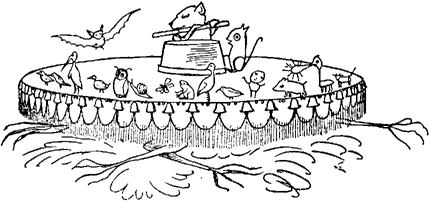
From The Quangle Wangle's Hat, by Edward Lear
On the top of the Crumpetty Tree
The Quangle Wangle sat,
But his face you could not see,
On account of his Beaver Hat.
For his hat was a hundred and two feet wide,
With ribbons and bibbons on every side
And bells, and buttons, and loops, and lace,
So that nobody ever could see the face
Of the Quangle Wangle Quee.
I know the first verse of "The Quangle Wangle's Hat" by heart, as I heard it as a bouncing-rhyme when I was a little girl. The poem continues with the Quangle-Wangle admitting loneliness, followed by a host of other creatures building their nests on his hat. There have been a couple of picture book versions over the years, but I haven't been thrilled with any of them. Modern slang and shifts in meaning of language have made people skitter away from reading some of my favorite poems aloud. The most (in)famous of them all is another poem by Lear, "The Owl and the Pussycat". I don't resent the shifts in language, but it does make me cross that we haven't retained the original meanings of some of the words. I hate changing the language of what someone else wrote to accomodate political-correctness. I'd rather not read the story or poem aloud at all. One notable exception, however, is the reworking of Helen Bannerman's The Story of Little Black Sambo into The Story of Little Babaji, illustrated by Fred Marcellino. What's my rationale? The story is terrific!
I do make changes when I read aloud as a parent to Lucia. In the Jenny Linsky books, a cat's "Indian feathered headdress" becomes "feathered headdress." Characters who are "gay" become "merry," and if I notice gender stereotypes, I comment on them.
This post has gone in a different direction than I had planned. Really, I was going to talk about hats. Traditionally, Lucia has refused to wear a sun-hat. The hats she's gotten are beautiful, but Lucia has a thick head of hair, and I can understand why wearing a hat in the heat would be uncomfortable. Yesterday, we were in an alternative children's clothing store, and Lucia was having a fun time trying on costume skirts and shoes. I found a blue hat with a simple patch in the shape of a goose that I thought might appeal to Lucia, even though I wasn't overly thrilled with it. Lucia enjoyed it, and I thought, "Okay, I'll get this for her." I had looked at the prices of the other hats in the store, but conveniently overlooked the price on the approved hat. It was only when the cashier was ringing up the purchase that it hit me: the hat I was buying for Lucia was more expensive than a hat I would buy for myself. I was embarrassed to admit I had made that kind of mistake (not the first time, either), so I let the purchase ring through. I admit I was also scared of my toddler's potentially explosive reaction to taking back a hat that she had chosen.
I brooded about the purchase as we walked toward the cafe where Bede was going to pick us up. I tried to rationalize the purchase, but couldn't. I just couldn't. The hat wasn't even very pretty.
I did take it back, though. Ten minutes later, Bede, Lucia and I walked into the shop, and I told the cashier, "This hat was an impulse purchase." The cashier was quite kind about the whole matter. (What had I been so afraid of?) As far as Lucia's reaction went, it wasn't as bad as I thought. As I write this, I cannot believe that I was going to let my fears of her potential meltdown determine my parenting and financial responsibilities. The past couple of days had been difficult, but still, what was the big deal?
I know what the big deal was. I've wasted a lot of energy and worry over the thought that Lucia's refusal to wear a sun-hat means I am a negligent parent, exposing her to harmful ultraviolet light despite the sunblock I've slathered on her skin. Before I had a child, it was easy for me to look at other parents and think, "Why don't they put hats on their children's heads? Why are the children running around without coats on? Why don't they just be really firm with their kids and MAKE them stop screaming?"
It's humbling to be one of those "other parents." I often blow things out of proportion. It's helpful to hear my mother say, "Look, when you were a baby, I didn't put sunblock on you, and you didn't even tan." It's helpful to hear my father point out that Lucia will know to burrow under the blankets if she gets cold in bed, and that we don't have to run the heat higher than normal to protect her little toes from the chill. New parents need experienced parents to point out when things are blown out of proportion. As a teenager, I used to get bent out of shape when the adults in my life pointed out how silly I was. Now, I could use a little more of those kinds of reminders. Like the Quangle-Wangle, maybe I need more creatures to build their nests on my hat.
If they do, though, I'm going to need a bigger hat!
Subscribe to:
Posts (Atom)


