Showing posts with label juvenalia. Show all posts

Saturday, November 04, 2006

Face to Face with Death:Redux

My mom sent me another package with my primary school short-stories, sketchbooks filled with drawings, letters, and the calenders she kept for the first two years of my life. Included in the package is my first murder mystery story, Face to Face with Death (first referenced here.)

I neither read nor liked mysteries, and I did not watch horror movies. In sixth grade, I went to a birthday party sleepover where the rented movie was "Jaws II." I protested, and we ended up watching a television movie called Charles and Diana: A Royal Love Story. How, then, do I explain wanting to write stories that would make my parents and peers faint with shock and dismay?

[Insert "Mwa ha ha"s plus flashes of lighting and crashes of thunder here.]
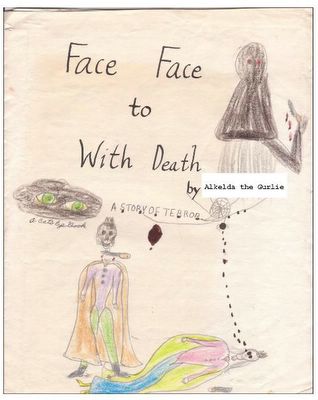


FACE TO FACE WITH DEATH: A STORY OF TERROR

By Alkelda the Gurlie, 10 years old Copyright 1982

The house didn’t look very scary. It was painted bright pink and the windows had colored glass. True, the paint was crumbly, and the windows weren’t dusted, and the steps had cobwebs and—well I could go on forever, but it didn’t seem true that the house was haunted. Let me tell you a story about that haunted house.

* * *

Mary Markman was walking past that haunted house (don’t ask me why) and all of a sudden she saw a shadow in the house, and being curious, Mary decided to check the house out.

Mary opened the door and found that it creaked. She left it open so she could identify it if she needed to go out quickly. Mary walked into a hall and found a corpse hanging by its neck. She ran for the door but with a creak, the door closed itself. Mary hurried to the door and tried to open it, but the door was stuck! She looked at the ceiling in anguish and drops of blood came dripping down.

All of a sudden a person jumped out with a wicked smile on its face. Mary gave a scream, and the person stabbed her with his knife. Then he cut off her head, and buckets of blood came pouring out! Mary was dead.

The next evening everyone was looking for her, and I mean everyone. Her lover Martin Gold was pearing [sic] into every nook and corner.

Martin was walking by The House when he gave a cry of surprise. There on the steps was Mary’s handkerchief!

Martin ran to tell everyone else, but they said, “Why don’t you search inside the house?”

“I will,” thought Martin. And so he did.

Martin threw open the door, and saw his lover dead with blood all over!

Martin was determined to find the murderer, so he ventured further. He saw the hanging corpse, but he did not cower.

Martin passed skeletons and bats, when he reached the end of the hallway. Suddenly a wall opened, and Martin was face to face with Mary’s murderer with a shining knife in his hands!

Martin whipped out his knife, and they had a battle, each thirsting for each other’s blood!

Suddenly the murderer threw his knife at Martin’s heart. Martin crumpled into a heap with blood and guts everywhere, for he was dead also!

The next day the missing lovers were in the paper, the police offering a reward to anyone finding them.

William Lovell was one of the people who read the paper. He too loved a girl who was Jane Telephone. Jane would have nothing to do with William unless William proved himself. So this was a good chance to prove himself to Jane.

William started to read the paper, and he found out that Martin Gold had gone into the old house. William decided to search in the house. Since he had been a Cub Scout when he was a boy, he took a knife, a flashlight, a camera and a poison dart gun. Then, he told a group of reporters to come to the house, and they agreed.

When they got to the house, William took a couple of reporters into the house. There they saw Mary and Martin dead. “Hmm,” William thought. “I’m going to have to make an investigation of this.”

“Really?” said a voice. William reached out for his flashlight, and turned it on so that it shone in the person’s face, and saw the murderer.

The murderer looked strange. It kind of shimmered like a ghost. It was a ghost! Then William thought, “I don’t know if I can drive away a ghost, but I’ll try.”

The ghost said, “I know what you’re thinking, coward.”

William said, “Coward yourself,” and with that he lunged for the ghost, but missed.

“Ha ha,” said the ghost. “There’s only one thing that can kill me! Ha ha!”

William thought desperately. Then he knew. His mother was very superstitious, and made William carry millet seeds “to drive away the ghost” she said. Fortunately, he still had them. [After reading the rough draft-- which coincidentally was also the final draft-- my father pointed out that you couldn’t kill something that was already dead. This revelation complicated the plot of my story, but I made the appropriate adjustments. After all, verisimilitude was important.]

“Really! I have a present for you,” and William threw the millet seeds on the ghost.

The ghost screamed and disappeared. “Thank goodness for that,” sighed William. “Now Jane will accept me.”

But he was wrong. Even though William was very brave, Jane said, “I’ll believe you if you make the lovers alive.”

“Good grief, Jane, why can’t you accept me as I am?”

“Do as I say, or I will never be yours.” And with that, Jane parted.

“What am I going to do?” thought William.

“I know,” said a strange voice, or was it strange?

“Who are you?” cried William.

“I am the ghost you fought and I have repented. I will go and return the lovers to life, and I will make everybody but you forget what happened.”

“Thanks,” said William, but the ghost was gone.

William was just going home, when he heard two voices arguing. They seemed to be arguing about relationships. William turned around to see—Martin and Mary! “But,” he thought, “the ghost must have gotten things mixed up.”

Suddenly, Mary came over to say to William, “I like you much better than that worm Martin.”

And William asked, “Really? I’m delighted!”

Suddenly, Jane came over and said to William, “I’ll never change my mind because Martin just asked me to marry him, so ha!” And she flounced away from him.

Surprisingly, William really liked Mary, and he really detested Jane.

“But,” thought William, “the ghost sure did change things, including me!”

THE END

About the Author
[These notes often appeared at the ends of my stories, along with book review blurbs.]

When Alkelda the Gurlie was 10, she wrote this book. She has written many books. One of her first books was called Elenor [sic]. She wrote that when she was 7.

Another book of hers was called Brown Berry, but nobody has read it yet. Still another from the pile was called Poems.

One day for Creative Writing, Mrs.T_____ (her 5th grade Reading/Language teacher) said that since it was near Halloween, that a group of people write a very, very, very scary story, and Alkelda, being a book and writer worm, wrote many pages [6 ½] to a book called Face to Face With Death. This is one of her best stories besides Invasion of the Chocolate Lovers, The Mystery of the Book Snatchers, and Invasion of the Queenflies. She is now working on a book with her [writing] partner, S______. If you have any questions, ask Alkelda the Gurlie, and she will be glad to answer them. Good reading!

Saturday, August 19, 2006

What Was I Thinking?

Inside my juvenalia folder, I found this drawing of a mermaid sitting on top of a sphere with accompanying snake:


It's dated 1988, and I am guessing I drew the picture around the time I had read Marion Zimmer Bradley's The Firebrand. As books went, it was pretty bad, but this retelling of the Trojan war through the viewpoints of The Women impressed me almost as much as Mists of Avalon. As E.A. Solinas wrote in her Amazon.com review, "With its use of sketchy characterization, blatant hyperfeminism, and constant fast-and-loose playing with both history and myth, [Firebrand] flops like a heavily decayed fish." (I have to laugh. She's right-- but I had fun reading it anyway.)

I am guessing that I drew the picture for a story in my head. I don't remember the story, but it probably had something to do with "mermaid vampires." What is it about certain girls' fascination with vampires? Were lot of those girls drawn to unicorns when they were younger? Maybe I have a thesis in the works somewhere...

Wednesday, August 09, 2006

Juvenalia Intacta

My mom sent me two packages of various items she'd kept for me over the years. In one of the packages was my complete juvenalia... not just the poems, but the short stories. I had photocopies of some of the poems, but I thought the juvenalia was probably lost in a basement flood (or basement fire, or something of that ilk).

Until I went to college, I would type in my age next to my name because I thought it was important. I thought that I was probably going to become so famous that my juvenalia would be in big, big demand. While it's fair to say there are some items that are thoughtful and well-developed for my various ages, the collection will probably be more of interest to my daughter when she's a bit older and writing stories of her own. Do I assume too much? I don't think so.

Addendum for Nonny:

I'm looking through the juvenalia for a story or poem to post. Can't. Do. It. I feel protective of my younger self. There are many cliches, exclamation points, urgent appeals to vampires (i.e. "night angels")... you know, the usual stuff. I was trying so hard to be serious and profound. I'm not saying that in a disparaging tone of voice: I really wanted to be serious and profound. Sometimes I tried to be funny, but it was forced humor. If I am going to be honest with myself (and by extension, everyone else), one of my overarching reasons for wanting to write was so that I could become famous and successful, and thereby show everybody that I was extraordinary after all.

Okay. One poem. I was twelve years old, heading for my thirteenth birthday. The year: 1984. The setting: Seventh grade English class. I've forgotten the specific creative writing journal assignment. It was one of the few times in which I was oblivious to any agenda:

River Rapids

River rapids
Flowing, crashing, thundering, breaking.
The little boat tosses and rocks with the waves.
Over and over again,
Flowing, crashing, thundering, breaking.
The river is harsh and loud,
but its continuing music is a lullaby.
Slowly, slowly, I drift off to sleep.
Drifting slowly and smoothly, the little boat comes to a stop.
The movements in the waves put me to sleep.
Now silence wakes me up.
My little boat is floating in a stream.
Sunlight breaks on the water, causing it to glisten with gold.
Green mossy banks and giant oaks surround me right and left.
The rapids are gone, I've finally stopped.
I'm safe now, able to stand up.
Yet, I felt safer when my life was in danger.

Wednesday, December 07, 2005

Blast/Past/Aghast/At Last


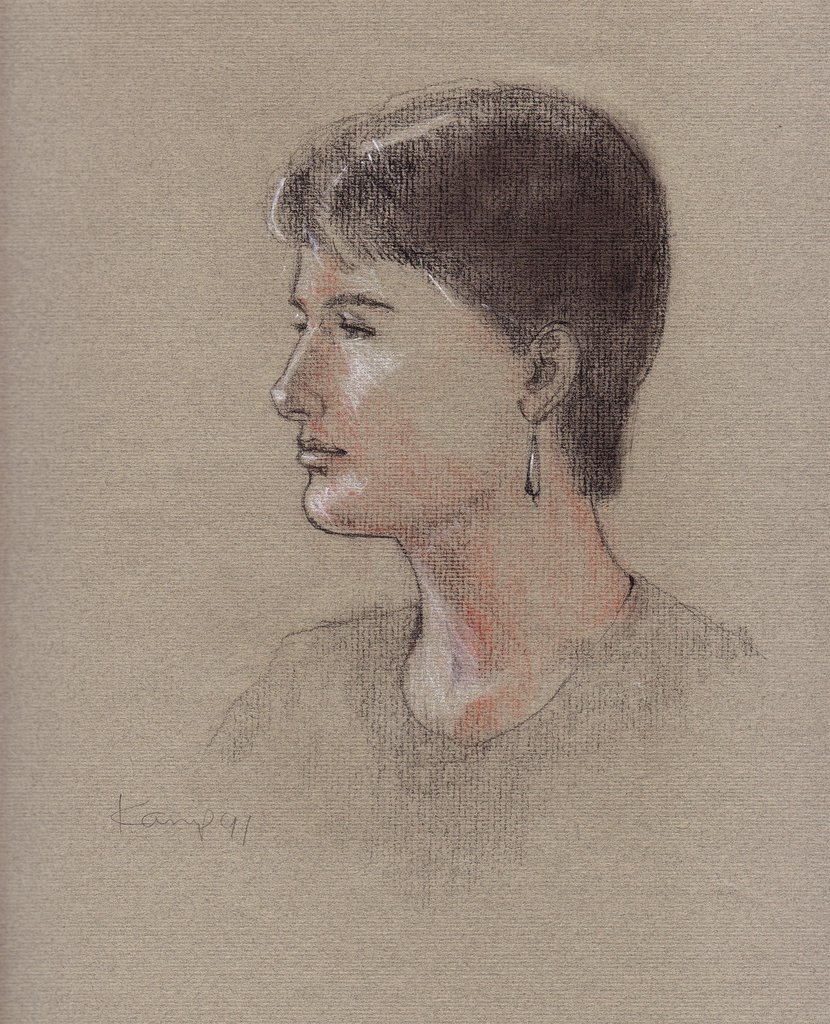
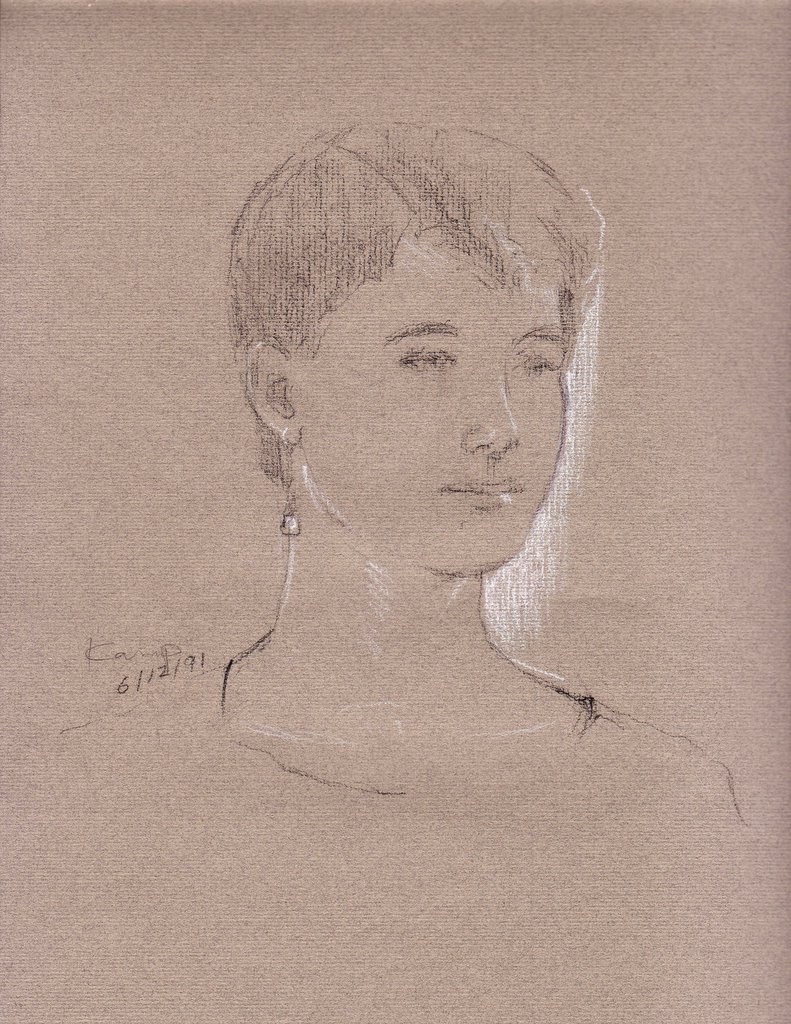
The summer after my freshman year of college, I commuted by bus to a government job in Greenbelt, Maryland. One day, a man I'd seen a number of times on the bus came up to me with photocopies of charcoal pictures he'd sketched of me. I asked him if he would sign them, and the man said that he would only sign originals. He then ripped the sketches out of his note-pad, signed them, gave them to me, and took back the photocopies. As it turned out, the man wasn't a total stranger, but the ex-boyfriend of one of my mother's coworkers. I don't remember his first name, but he signed his last name, "Kamp" on the sketches, so I'd like to give him full-credit for his own sketches.

These sketches, along with a host of other objects, arrived in a large box this afternoon.What struck me most about the portraits was not so much that they looked like me then, but how I would look ten years later.

As I looked through ancient journals, juvenalia printed out on an actual typewriter, and other potentially embarrassing things, I expected to reel in disgust. I didn't. What a relief! Of course, the poems were filled with murky, overblown images inspired in equal parts by my adolescent struggles and Simon LeBon's lyrics. (Does this sound familiar, O Goddess of Clarity?!) However, I can read the poems and remember what I was thinking at the time I wrote them. For example, I submitted a poem to Cricket Magazine. The subject matter was supposed to be about clouds. This is the poem I sent:

Beneath the clouds of midnight
The gale of dream blizzards blow
Sweeping icy splinters of hate into the hearts of mortal men
Chilling the bare hope that eternity exists
Where wishes live between the songs of lemon trees
Ever convicted to lie in wait for the rebirth of the moon’s daughter
Shadowed silhouettes dance on blades of grass
Stained with the blood of a thousand years hence
One hundred whispers sway in the breeze as one:
“Pass by quickly, child, pass by quickly.”
But I will never be a child again.
--Alkelda the Gloomy, age 13, 1985


Nevermind that nonsense about "songs of lemon trees"-- that was classic Simon LeBon obscurity. I stuck in the "clouds" so that the poem would technically be eligible for the contest. My mother gently pointed out that this poem was probably not what the editors had in mind when they asked for "clouds," but I was undeterred. I wanted to be treated as an adult. I had no idea what that concept truly entailed, I equated innocence with naivete, and I wanted to stop being treated like a child. I wanted my writing to have the depth of a grownup's.

Ironically, it was around the time of my brother's death that I finally got it: there is enough world sorrow. There is more than enough pain. No matter what we do, we will always have struggles. Therefore, why not encourage joy? Why not remind you of the times you laughed? Why not make you laugh again?

Saturday, August 06, 2005

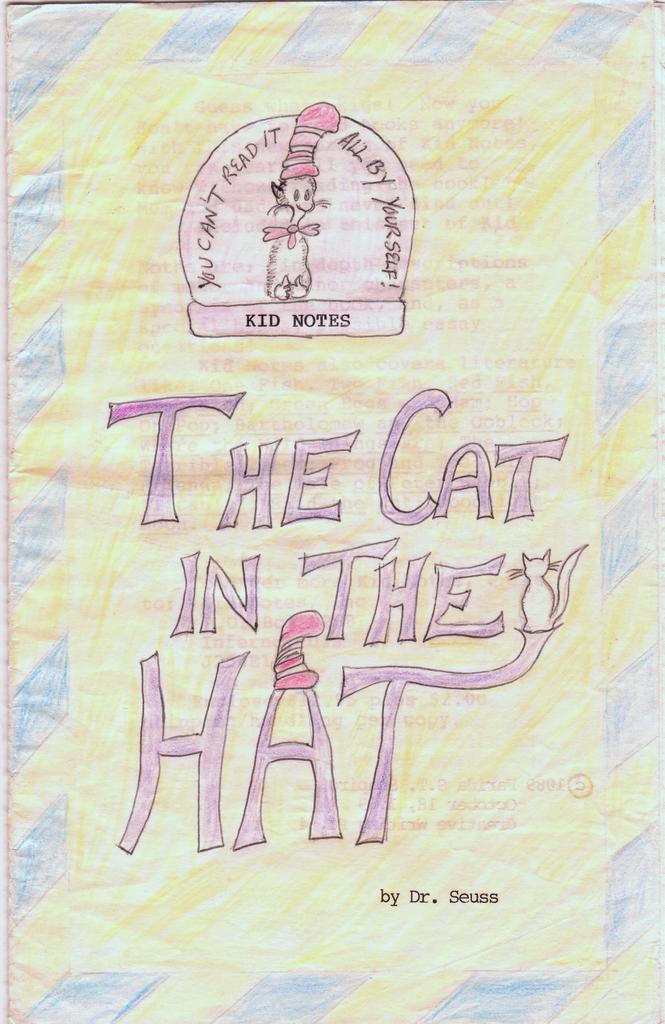
Cat in the Hat: a Reluctant Reader's guide

Carissa of Happy Stuff asked me "Will you grace us with any of the treasures that your parents saved?"

Now, how can I refuse a request like that? Instead of torturing you with poems about the last unicorn,* followed by poems about my loss of innocence** (inspired by the cryptic verses of Simon Le Bon), followed by poems about how cross I was with my first boyfriend,*** I shall offer you my favorite project from my high school senior year creative writing class: The CliffsNotes version of Dr. Seuss's classic text, The Cat in the Hat.

Major Characters

Theodore Geisel—The narrator of the story. He is protective of his sister, but rather confused at the tender age of four. He wants to be good, but feels powerless in the face of evil.

Sally Geisel—Theodore’s younger sister. Sally is only two years old. She embodies the virtue Innocence. Sally shows complete trust in Theodore, even when he cannot avoid catastrophe. Sally does not talk, and she trusts that Theodore will voice her concerns and fears.

Fish—His true name is Simon, but is only addressed as “Fish” throughout the story. He is silent and content in his bowl of water until the Cat in the Hat appears. He then becomes gifted with speech. Simon is also able to poke his head out of the water and shake a fin at the Cat in the Hat in lieu of a forefinger.

The Cat in the Hat—The anti-hero of the story. He invokes mayhem and terror, but really means well. He surprises everyone in the end by taking responsibility for his actions.

Mother—Little is known about her, and the fact that her face is never shown only adds to the enigma. She is away for most of the story, having left Theodore and Sally to take care of themselves. While a number of critics believe she is a negligent parent, others believe she is simply trying to teach her children responsibility. The children have no father, since he left Mother when Sally was born. Nothing is known about the father except that he may have been a convict.

Thing One—a friend of the Cat in the Hat’s trouble-making friends.

Thing Two—Thing One’s twin brother. He is also one of the Cat in the Hat’s troublemaking friends.

Synopsis of Story

Section I: It is a cold, wet, rainy day. Theodore and Sally are left home alone by Mother. Since there is too much precipitation to play outside, the children sit by the window in complete ennui.

Section II: Theodore and Sally hear a “bump” at the door, and the Cat in the Hat strolls in. He promises a plethora of amusements for the children, and proceeds to balance objects on various parts of his body while standing on a ball. They are: the Fish in his bowl, two books, a cup, a teapot, a cake, a toy ship, a toy man, milk in a dish, a rake, and a red fan. The Cat in the Hat loses his balance, much to the chagrin of Theodore, Sally and the Fish. He falls, and the Fish lands in the teapot. The Fish tells the Cat in the Hat to go away. Theodore and Sally feel helpless.

Section III: The Cat in the Hat refuses to leave, and brings in an enormous red box using his Herculean strength. He opens the box, and Thing One and Thing Two pop out. Thing One and Thing Two start flying kites in the house. They also string up Mother’s red and white polka-dotted dress along the kite cords. Theodore and Sally are disconcerted.

Section IV: The Fish sees Mother coming home, which dismays the children. They finally exert control over the situation and with nets catch Thing One and Thing Two. Theodore and Sally order the Cat in the Hat to take them [Thing One and Thing Two] away. Dejectedly, the Cat in the Hat complies. Unfortunately, Theodore and Sally must now clean up the house, which is in shambles.

Section V: The Cat in the Hat returns with a magic machine to clean up the house. He assures Theodore, Sally and the Fish that he always cleans up after he plays. This is the author’s lesson to children. The Cat in the Hat finally exits, tipping his hat as he goes out the door. Mother returns soon after, and asks what the children did while she was out. The children do not know what to say.

Possible Essay Questions

1) Describe the symbolism of the characters using Freud’s psychology.
2) Contrast the morals of the Fish (Simon) and the Cat in the Hat.
3)Discuss the symbolism of the two books the Cat in the Hat balances (Divine Comedy and Aeneid.)
4) Compare the character of Theodore with that of Hamlet.
5)"Have no fear… I will not let you fall." Discuss the meaning of this quote and how it pertains to the book as a whole.

----------
*As if there's any other kind but the "last" unicorn.
**Rough translation: "My parents don't understand how hard it is to be thirteen years old."
***Eighteen years later, we're actually friends again. I'm not cross anymore.

Thursday, August 04, 2005

Murder in the Mansion and the Immortal Beloved

My first novel

When I was in seventh grade, I hand-wrote a nineteen page story called “Murder in the Mansion.” I decided it was my first novel. The main character, a 17 year old heiress named Diana, is to meet the other 2/3 of her triplet sisters for the first time. The signature feature of each sister is that Diana has brunette hair, Julia has blonde hair and Cynthia has red hair. Cynthia turns out to be the most interesting character of the bunch: she is fiesty and very, very angry. It is revealed at the climax that she is in fact Diana’s mother, and has killed off Diana’s real sister Cynthia in order to pose as Diana’s sister and claim the inheritance Diana’s mother thinks rightfully belongs to her. Diana eventually pushes the false Cynthia out of the window.

You have no idea how disappointed I was to return to my junior high school to reclaim my English writing folder (the one that all the teachers said would follow me around until the end of time, that I could not escape even if I moved to Japan), only to find out that it had been thrown out three years earlier. The teachers all asked me, “You didn't have a copy on a computer disk?” conveniently forgetting that when I was in seventh grade, not many children in my class had computers in their homes. Fortunately, my mother was a better banker,* and underground classics such as "Face to Face With Death" and "Revenge of the Zombie Sock-Monkeys"** remain safe in my childhood travel trunk.

My second novel

When I was a senior in high school, I typed up two chapters of a historical novel based upon the mysterious lover of Ludwig van Beethoven, the Immortal Beloved. You might think that I was simply copying the movie, only I graduated from high school in 1990 and the film starring Gary Oldman as Beethoven wasn’t released until 1994. My main character was an Austrian widow named Xanthe Alighieri, who had once had a promising career as a pianist, but was married off to a cruel baron instead of her lover, Beethoven. I don’t remember too much about the two chapters except that I tried so hard to make them historically accurate. With a straight face, I warned my creative writing teacher that she needed to be prepared for a steamy romantic scene in chapter three. My teacher reassured me that she could handle the heat. I stopped work on the novel after I went to college, and when I returned to it a year later, I was so appalled by the writing that I nearly chucked it out the window, much as Diana did with her treacherous mother in "Murder in the Mansion."

My third novel

My third novel is still a work in progress. It's had three different incarnations. It may take my whole life to write, depending upon how long I live. I used to try to write serious, inspiring stories that would (take a deep breath) show all my wretched classmates of yore that just because I was unpopular and a lousy student didn’t mean I wasn't a genius. A genius! Now, I should just write what I love to read. There's no shame*** in creating escapist quest-fantasy fiction, especially if I use The Tough Guide to Fantasyland.

I know that it’s not my job to be a genius. It’s not my job to write deep, enduring literature and win awards for doing so. It’s my job to tell you stories.

Here’s what’s coming up in the next month:
1) That puppet show I keep promising to produce
2) A story involving the phrase “drive the bus”
3) A new version of a tale of Fionn MacCumhail
4) A list of nursery rhymes to sing to the tune of “Twinkle, Twinkle”
5) (This one is up to you)

----------
*Both my parents were quite supportive of my writing, although they often laughed when I wanted them to shiver with dismay.
**I am kidding.
***See above.