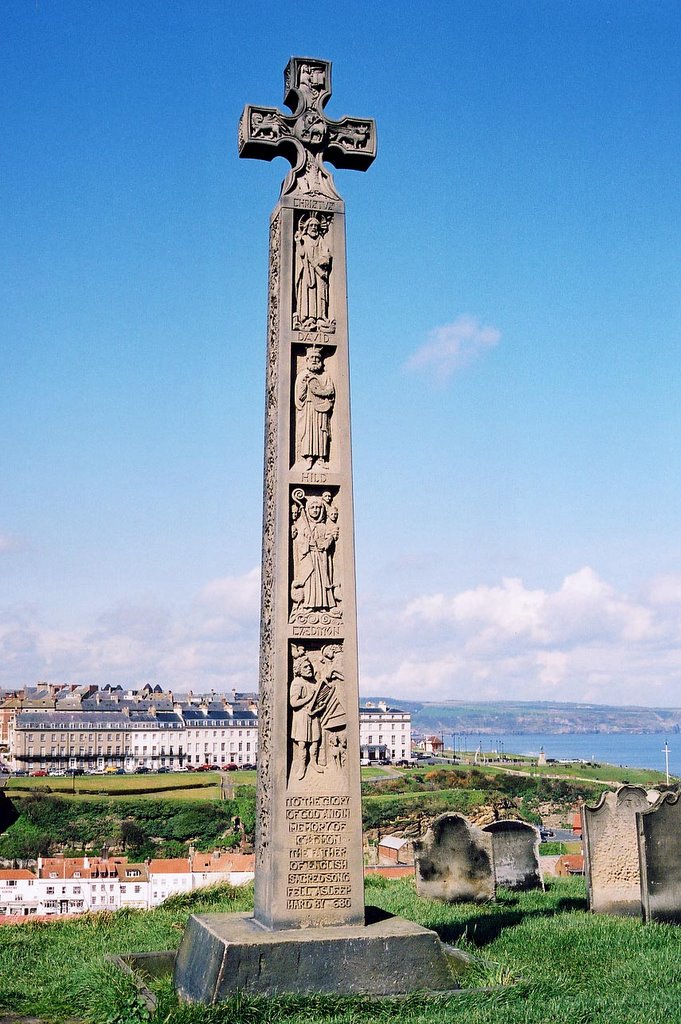
St. Caedmon has no officially assigned patronage
(and in fact, isn’t even a formally canonized saint), but I think of Caedmon as the patron saint of sacred lyrical poetry. Although history has retained only eight lines of Caedmon’s verses, the
Venerable Bede said that Caedmon composed many more wonderful pieces. I believe the Venerable Bede.
It haunts me that we can lose people’s creations so easily. I think of the desecreation of the
Royal Library of Alexandria, and more recently, the
National Museum of Iraq. What can I say? There is nowhere I can even begin to do justice to commemorate what we have lost.
However, I can tell you about Caedmon, and then you will know another story. By the way, “Caedmon” was what we chose for our baby’s name were we to have had a boy. I am guessing that most people will think our child was lucky she was born a girl (that "ae" is a difficult
dipthong that is open to interpretation depending upon which language rules you follow), but I still think of “Caedmon” as Lucia’s boy-name.
 Caedmon's Hymn, or "What Shall I Sing?"
Caedmon was a cowherd for the great monastery of Whitby. He was shy and slow of speech, but he loved the cows and often talked to them. While he was courteous and pleasant to the other farmhands, his shyness kept him from becoming good friends with them.
At the end of the day, all the farmhands would gather together and sing songs about the great heroes of the past. They passed the lyre from one farmhand to the next, but Caedmon always let the lyre pass him by. The very thought of singing in front of everyone made his knees wobble and his mouth dry up.
It was different in the barn. Sometimes, Caedmon would make up a little song and sing it to the cows. One song he had was only a line long:
“Living Lord beginning made—ah…”It was a little song, but it was a good song. The cows listened, and perhaps the angels listened too, but Caedmon didn’t notice that, as he went about his work, the other farmhands began to overhear the song too. They joked to each other, “Caedmon’s in the barn, chewing the cud, just like the cows!” but they didn’t bother him, for they knew he was shy.
However, one night, after the a great feast in the farmhand’s dining room, the lyre went around the room, and someone called out, “Caedmon, it’s your turn to sing something for us!”
Caedmon’s knees shook and his tongue dried up in his mouth. He stumbled to his feet and ran to the door. “I’ve got to look out of the cows!” he said. Once Caedmon reached the barn, he felt better. He checked on all the cows, and then curled up in some hay and fell fast asleep.
Caedmon dreamed. In the dream, a man appeared before him and said, “Caedmon, sing me something.”
“I don’t know how to sing,” Caedmon said. “That is why I ran away from the feast.”
“You do know how to sing,” the man said. “You sang for the cows, and now you shall sing for me.”
“What shall I sing?” Caedmon asked.
“Sing to me of creation,” the man said.
Caedmon opened his mouth and began to sing. He didn’t think about what he should sing, and the words just came out of his mouth:
Now hail we heaven-kingdom’s Lord, the
Measurer’s might, and His mind’s thought, the
Wonder-father’s work! Of all things He the
Living Lord beginning made—ah!
First He raised heaven’s roof on high, that
Holy Shaper, for sons of men—ah!
Middle-earth then mankind’s Lord, the
Living Lord, with all life filled, for
All men’s sons, Almighty God, ah!*
When Caedmon woke from his dream, he felt a confidence he had never had before. He decided he must tell his dream to his boss, the reeve who ran the farm. When Caedmon sang, the reeve said, “We must go to the Lady Hilda and tell her your dream.”
“Lady Hilda?” Caedmon asked. “The
Abbess?”
Caedmon’s newfound courage began to waver, but the reeve said, “Yes, the Abbess will want to hear about your dream.”
When the Abbess Hilda heard Caedmon’s song, she called to all of the monks and nuns to listen. “The man who appeared to you in your dream was an angel,” Abbess Hilda said.
“Yes,” Caedmon replied, and bowed his head.
The Abbess Hilda asked Caedmon to sing other songs. Someone read aloud the story of Adam and Eve, as Caedmon himself did not read. Caedmon mulled it over during the night, and in the morning, had composed another song. That is how Caedmon spent the rest of his days. He became a brother in the monastery where he listened every day to the sacred stories. After he listened, he chewed over the Word as cows chew their cud, and when he was ready, he brought forth new songs.
It is recorded that Caedmon died on February 11, AD 680. There is a carving of Caedmon (pictured below the Abbess Hilda) on a cross in Whitby, Yorkshire North Riding, England. Below his picture are the words:
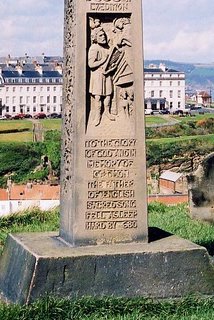 Caedmon
To the glory of God and in
memory of
Caedmon
The Father of English
Sacred Song
Fell asleep
hard by 680*
Caedmon’s story comes from Bede's History of the English Church (Book IV, Chapter 24) . My short version is heavily influenced by Robert P. Creed’s storytelling, and the actual hymn translation is directly quoted from Creed's version of the story, “How Caedmon Got His Hymn.” You may find Creed's text version in Best Loved Stories: Told at the National Storytelling Festival.

 Click on the button for more Poetry Friday poems.