Tuesday, May 31, 2005

Bactrian camel in felt

Lucia and I attend a weekly parent-toddler program. For the first hour of the class, the children play and help make the muesli snack while the grown-ups participate in various craft projects. When grown-ups are working at tasks that the children can observe and sometimes even assist, the mood is both energetic and mellow. After the first hour of play, we all sing songs in a Circle Time, and then we prepare the room for the muesli snack while the teacher sets up the story in the next room. The teacher uses objects from nature like leaves, branches, rocks, and pinecones for the setting and hand-made felt and knitted figures to act out the stories. Afterward, we walk outside and feed the brood of chickens (give into the temptation to click on this link; you won't be sorry! June 2, 2005: I changed this link because the original one frizzled out.)

One of our projects earlier on was to design and sew felt animals for our children. You may recall my first effort, the duck/goose creature. Now I am working on more ambitious projects. So far, I am most pleased with the Bactrian camel:


I am posting my pattern in the event you wish to design and make some version of the camel:


Thursday, May 26, 2005

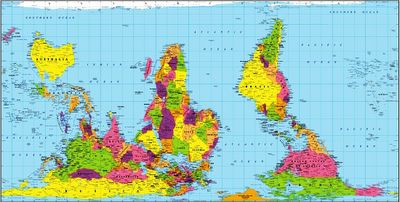
A Map of the World


New Ways to See the World 

"Perhaps we share stories in much the same spirit that explorers share maps, hoping to speed each other's journey, but knowing the journey we make will be our own." --Gloria Steinem

Monday, May 23, 2005

"The Storyteller" by Jim Henson

Bede and I are about half-way through our DVD of Jim Henson's The Storyteller. There are nine episodes of lesser-known fairy tales done with a mixture of live-actors and muppet-like creatures. We have enjoyed them, and thought the stories faithful to the originals for the most part. However, the episode ending to "Fearnot" (also known as "The Boy Who Left Home to Find out About the Shivers" is quite different from the original telling. You can read an excellent translation in Ralph Manheim's Grimms' Tales for Young and Old.


Addendum: Here is the text of "The Story of a Boy Who Went Forth to Learn Fear," which is in essence the same story. However, the title is a bit misleading, as the boy never does learn about fear, but rather, the physical effects of fear, i.e. shivering and shuddering.

Saturday, May 21, 2005

Alien Abductions and Glass Slippers

As I was looking for different versions of stories where a trickster steals a cooking pot by convincing the owner that the pot has died, I came across this handy website: Folklore and Mythology
Electronic Texts
. I've linked it in the side-panel under Recommended Reading* so that you may find it again. You never know when you're going to need a story about an alien abduction or a legendary case of flatulence.


In other news: after years of believing that Cinderella's glass slippers were actually fur slippers but mistranslated from the French, I discovered that Charles Perrault had meant all along for the slippers to be glass. No kidding, you are probably thinking. Who would wear fur slippers to a French dancing party?

Glass slippers aren't practical, either, but at least they're shiny.

*No longer linked. So it goes.

Thursday, May 19, 2005

Quirky Saints


Simeon of Stylites waiting for his lunch 

Sometimes it's obvious as to why a saint is the patron of a particular discipline or struggle. Other times, it's a bit of a stretch. Here are four saints whose stories are much like the pictures of constellations: you have to squint and look at them from different angles in order to figure out how they came to be recognized as saints with particular areas of expertise.

Magnus of Füssen:
Saint invoked against caterpillars, perhaps because he spared a baby dragon who helped farmers get rid of pestilence. He also had a way with animals: once, a bear in the woods showed Magnus a vein of iron ore, and Magnus gave the bear some cake.

Neot:
Patron saint of fish. Neot spent much of his day in a well up to his neck in water while he practiced his devotions. He definitely gets points for style.

Simeon of Stylites:
There are discrepancies as to exactly how many decades Simeon spent atop a pillar, but he started a whole movement of pillar dwelling among Eastern hermits. While he has no official patronage, I think of Simeon of Stylites as the patron saint of people who sit upon poles. You know who they are.

Vitus:
When Vitus was martyred by being thrown into boiling oil, a rooster was thrown into the oil with him, sacrificed as part of the ritual against sorcery. Hence, Vitus is the patron saint invoked against oversleeping.

Wednesday, May 18, 2005

Rabbit in the Sky


Rabbits and hares get mixed up just about as much as ravens and crows. In nature, rabbits are not as large or as fast as hares, nor are they as equipped to deal with the world when they are babies: rabbits are born naked and blind, while hares have fur and vision. Rabbits are homebodies who like to stay close to their warrens and live in social groups while hares lean toward the nomadic lifestyle. In folklore, however, rabbits and hares are interchangeable as long-eared tricksters with powerful legs for quick getaways and the brains to outwit their enemies.

Some cultures have a tradition of a rabbit in the moon, but if you want to see a rabbit in the stars, you'll have to look a bit harder. Lepus the rabbit (or hare!) sits at the foot of the constellation Orion. It's not too hard to find Orion's belt, but frankly, I never knew about the existence of Lepus until recently. As with most constellations, imagination is a key ingredient to finding the pictures.

Saturday, May 14, 2005

Crows' Counting Rhyme


This old rhyme is one of several versions that uses crows to tell fortunes.

One for sorrow
Two for mirth
Three for a wedding
Four for a birth
Five for silver
Six for gold
Seven for a secret not to be told.

Wednesday, May 11, 2005

Storytelling with Russian Nesting Dolls, part 1

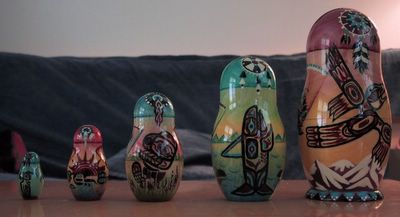
For Mother's Day, I received a set of matryoshka dolls hand-painted as a family of five Inuit women and girls with animal totems. (Just so you know for your searches, other Anglicized spellings of this Russian name Matryona meaning "little mother" include matreshka and matrioska.) Preliminary research in Google Images on the different designs for matryoshka yielded some surprising (and slightly scary) results in addition to the beautiful creations we've come to expect. I found nesting dolls of the Beatles, the band KISS, divas of American pop music, plus a few politically-themed sets that made me want to avert my eyes in modesty.

This set, however, is my cup of tea.
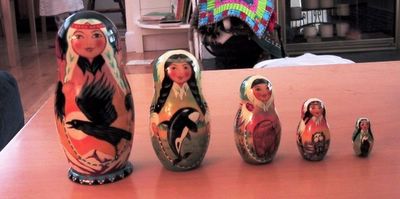


I found the dolls painted in the style of Haida American Indian art in a shop in the downtown part of my city. When I saw them, I went weak in the knees. These matryoshka were the dolls for which I had been waiting. After agonizing over the price, I decided that they would be a fitting Mother's Day present. I brought them home to Bede, made my intentions known, and pretended to forget that they existed so that I might be surprised later. It worked (mostly). Bede said, "They are exactly the sort of matryioska I would have picked out for you," so I did not presume too much.

I will attempt to show you my version of "Little Marysia," following the model from Anna Pellowski's collection of tales,The Storyvine. Pellowski's version has an agricultural setting. My version takes place in a library or bookstore, or any other place where I am getting paid. It'll take a few days to get the photo-essay together. If you have an idea of where the story should take place, please leave a note in the comments field. The winning entry will receive a free saint.

Addendum 05/19/05: I don't think there's going to be a "part two" any time soon.

Thursday, May 05, 2005

The storytelling consultant/ A story about Owl

I want Cathyrn Wellner's job. She is a storytelling consultant. As I was looking for the full-text of Diane Wolkstein's "Owl" to link, I came across Wellner's essay about storytelling for teens on her Finding Voices website. There are a lot of good things to read in this essay, but I will just quote the section on the appearance of failure:

...On those days when I have tried my best and still feel as if I have failed, I recall the experience of Jay O'Callahan, one of America's best-known storytellers. He told "Raspberries," a marvelous 45-minute tale he created, to a school assembly. The crowded auditorium held hundreds of young people from ages twelve to fifteen. In the back of the room, two boys danced around during the whole session, never once looking at Jay.

Although he had caught everyone else's attention, Jay could not stop thinking about those two boys. He left feeling discouraged and unhappy. The next day, the school principal called. The two dancers had repeated the entire 45-minute story to an enthralled group of their classmates. What one couldn't remember, the other one did.

We never know what effect the stories are having on the people who hear them. Concentrate on those whose interest shows on their faces. Their nonverbal encouragement will help you to do your best. Beyond that, trust in the stories you have chosen with such care.


***
The story of "Owl" for which I was looking is one that you can read at this link (scroll down to page 4). The first paragraph:

Owl thought he was very ugly. But one evening he met a girl and talked with her and she liked him. “If it had been day,” Owl thought, “and she had seen my face, she never would have liked me.” But still she had liked him.

"Owl" is definitely a young adult story. It ends with poignancy and regret. I was going to tell this story at a storytelling festival in Maryland, but conflicts with the venue led to the festival's cancellation for that year. The next year, I was no longer a Maryland storyteller. "Owl" never made it into my regular repertoire, but like the girl in the story, I sometimes think of Owl and wonder how he is.

P.S. J.K. Rowling asks people to refrain from their desires to keep owls as pets.


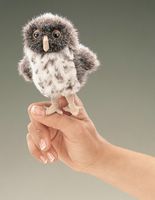
An owl puppet might be a good compromise.